
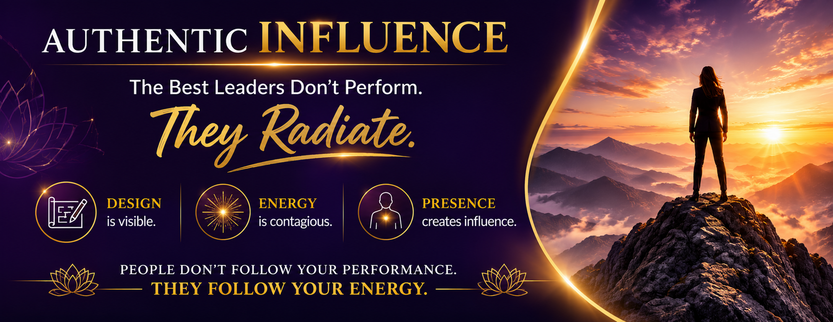
For years, I believed influence was something you built. You learned the right language, mastered the right frameworks, practiced the right posture before a big meeting. Influence was a skill you performed, taught the same way most business strategy is taught, most executive coaching is delivered, and most leadership training is designed.
Then I survived an aggressive form of cancer that had already claimed every woman in my maternal bloodline. Somewhere between the diagnosis and the recovery, the performance stopped working. What was left was simply how I showed up, and people responded to that more than they ever had to the polished version of me.
That was the beginning of what I now teach as the Three Laws of Sustainable Success: Design, Energy and Capacity. Most leadership development and executive leadership programs teach the Law of Design, the vision, the systems, the plan for scaling a business, without ever addressing the Law of Energy underneath it. What they never explain is that Design only organises what is already running beneath a leader. It cannot generate the frequency itself. And this is why the same business strategy, executed by two different leaders, produces two entirely different results.
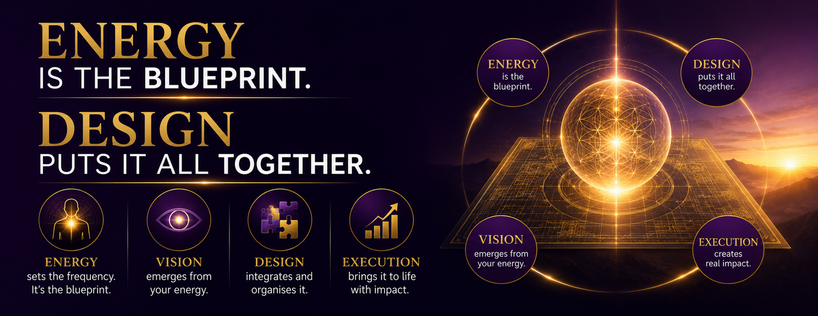
Energy Is the Blueprint. Design Puts It All Together.
A leader can have the right vision, the right team, the right business growth strategies, and still hit an invisible ceiling. Not because the strategy is wrong, but because of what it was built on. Energy is the actual blueprint: the frequency a leader is operating from before a single plan is ever drawn. Design does not create that frequency. Design is what integrates it. It takes the energy running beneath a leader and organises it into vision, methodology, planning and execution that can move through the world.
A leader running on adrenaline or unresolved pressure can still deliver strong business performance for a while, because a talented team can design around almost anything. But teams sense what the design is built on, even when they cannot name it. There is a difference between strategic leadership that is convincing and leadership that is congruent. One drains a room. The other lifts it. This is why influence that is only performed eventually runs out, and why entrepreneurial success built on real alignment does not.
Capacity Is What Makes It Sustainable
The third law, Capacity, is the most overlooked in traditional business transformation work. It is not stamina or discipline. It is how much energy a leader can actually hold and transmit without distortion, over time. Energy provides the current. Design gives it form. But without Capacity, even a well-designed business running on transformed energy collapses back under its own weight, because growth outpaces what the leader can sustainably hold.
All three operate together, always. A business can have flawless business execution and still feel hollow if the energy it was designed around was never transformed. It can have transformed energy and sound design and still stall if the leader’s capacity to hold it hasn’t expanded.
Radiate, Don’t Perform
The leaders who last are rarely the ones working hardest to be convincing. They are the ones who have done the quieter work: designing with clarity, transforming the energy beneath their decisions, and expanding their capacity to hold what they’ve built, so that influence becomes a natural output, not a daily performance.
This is exactly what I will be exploring at the Leadership Activation Summit, a leadership conference and business conference alongside Dr. Pavla Križman Lavrič this October in Thermana Laško: the Three Laws behind leaders who don’t just perform success, but embody it.